- Téléphone : (+255) 684 373 797
- E-mail: info@codewatz.org
- Bonde Buildings, Zimamoto Street, Tabora - Tanzania

Tanzania's law gives every girl the right to return to school after childbirth. GDASH exists because a right on paper and a right in practice are two different things. We close the gap between the law and the lived reality, training out-of-school girls and young mothers in AI tools, coding, and digital entrepreneurship so that no girl's future is decided by a community that forgot her.
The Story Behind the Programme
Salma was seventeen when she gave birth. She had been one of the top students in her school, the kind of girl her teachers quietly hoped would go on to university. Six weeks after her baby was born, Salma tried to go back. The law was on her side. Tanzania's education system explicitly permits girls to return to school after having children. She had every legal right to be in that classroom.
She lasted one week.
The whispers in the corridors were unbearable. A teacher suggested she sit at the back so as not to distract the other students. Her classmates made sure she knew she no longer belonged. By Friday she had left and she never returned.
Salma did not leave because the government failed to make space for her. The government had. She left because the community filled that space with something the law could not reach: stigma, silence, and a message that she no longer belonged.
When CODEWA found Salma, she had been at home for nearly two years, watching younger students walk past her window on their way to school. She had not stopped wanting to learn. She had just stopped believing there was anywhere left for her to go.
When we told Salma she would learn AI tools used by professionals in New York and London, she laughed. Then she asked when she could start.
GDASH exists because Salma exists. And because across Tabora there are hundreds of Salmas, brilliant, legally entitled to a future, and failed not by their government but by the gap between what the law says and what their community does.
The law gave her the right to return. Her community took it away. GDASH gives it back.
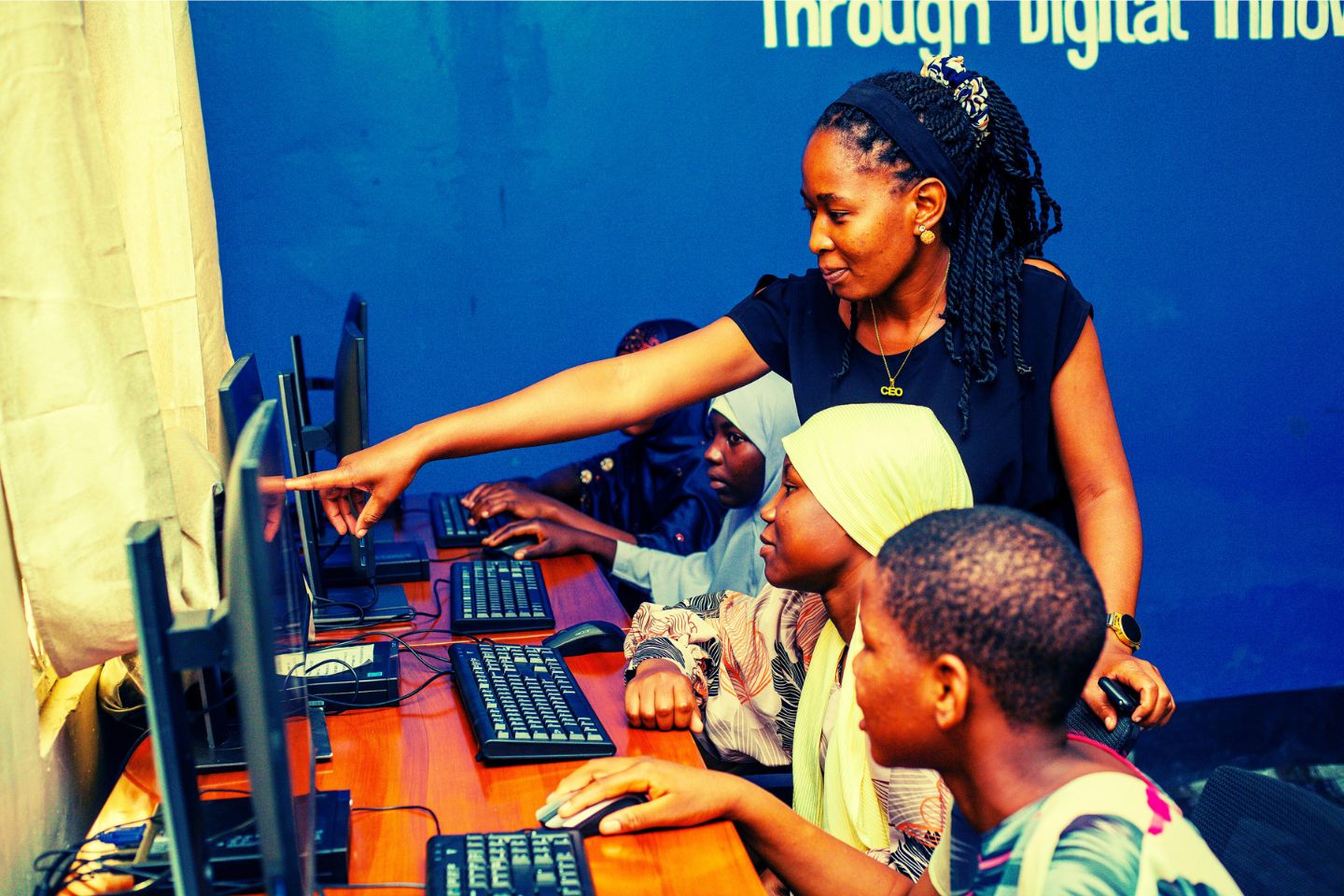 GDASH in Action
Tabora, Tanzania
Girls Digital Access and Skills Hub
The Scale of the Challenge
Tabora Region is not an average part of Tanzania. It is the region where the crisis of girls exclusion is most acute, documented in CODEWA's own 2018 Hidden Barrier Study and confirmed by national education data. The Tanzanian government has taken meaningful steps to keep girls in school and to support their return. GDASH exists not to replace those efforts but to reach the girls who fall through the gap between policy and practice, the ones the formal system has not yet been able to hold.
Tanzania's highest regional dropout rate, driven by poverty, early marriage, teen pregnancy, and the gap between legal entitlement and community reality.
More than half of girls in Tabora are married before adulthood, cutting their education short before it has the chance to change their economic trajectory.
Nearly one in four girls in this age group is already a mother. Once she leaves school, the practical barriers to return compound with every passing month.
Source: Tanzania National Education Data | CODEWA 2018 Hidden Barrier Study, Tabora Region
These girls are not incapable. They are not unwilling. They are caught between a law that includes them and a community that has not yet caught up. That is the gap GDASH fills.
Feuille de route stratégique
Out-of-school girls and young mothers in Tabora Region receive daily Dignity Circle psychosocial support alongside four months of professional AI, coding, and digital entrepreneurship training in a safe, inclusive, childcare-equipped, and solar-powered Hub, at no cost to participants...
. . .They rebuild confidence and self-worth, develop globally competitive technical skills, complete verified professional portfolios, and launch BRELA-registered micro-enterprises with real clients and real income...
. . .A generation of Digital Sisters in Tabora who earn independent incomes, mentor the next cohort of learners, and demonstrate publicly and permanently that a girl's future is not determined by the moment the community pushed her out.
Every participant enters GDASH carrying a label she did not choose. She leaves carrying one she earned: Digital Sister, entrepreneur, graduate.
Graduates earn between 50,000 and 150,000 TZS per week through Digital Service Kiosks, an income that did not exist in their household before GDASH.
Every GDASH graduate who succeeds publicly rewrites what is considered possible for girls in Tabora. Every cohort makes it harder for the community to maintain the story that these girls had no future.
Nos Piliers Stratégiques
GDASH was not designed in an office. It was designed from evidence, CODEWA's own 2018 Hidden Barrier Study conducted in Tabora, and from years of direct community knowledge. Every element exists because the evidence demanded it, and because the community it serves helped shape it.
Every training day begins with a Dignity Circle, a structured psychosocial session co-designed with past programme beneficiaries. The Circle addresses trauma, processes stigma and social exclusion, rebuilds identity from dropout to Digital Sister, and establishes the emotional safety that makes technical learning possible. It runs every day for the full four months because healing is not a one-off event.
Month 1 builds digital literacy foundations including computer fundamentals, internet safety, and AI concepts. Months 2 and 3 introduce ChatGPT, Gemini, Claude.ai, HeyGen, Canva, and HTML and CSS coding with AI assistance. Month 4 delivers portfolio development, client communication, pricing, business planning, and Digital Service Kiosk launch.
The programme runs from 9:00 AM to 12:00 PM, designed around young mothers domestic realities. A dedicated Childcare Corner operates during every session. Young mothers consistently achieve among the highest completion rates in the programme. Motivation was never the issue. Access was.
All graduates retain access to the Hub through the Lab Residency programme. A revolving Alumni Fund provides micro-grants to top graduates launching Digital Service Kiosks. Graduates who excel return as junior mentors for the next cohort, creating a cycle where every Salma who succeeds opens the door for the next one.
The Research Behind the Design
In 2018, CODEWA conducted a formal Hidden Barrier Study in partnership with Dr. Pierre Rialland, PhD in Economics from the University of Essex and Economist and Policy Analyst at the European Commission. The study was conducted in Tabora Region to understand why existing programmes were failing to retain out-of-school girls even when material barriers had been removed.
The findings were clear and consequential.
Trauma, low self-esteem, and social isolation were the primary barriers blocking girls participation in education and training. The Tanzanian government's policy had opened the door. But the psychological and social damage done by exclusion and stigma was keeping girls from walking through it.
GDASH is not built on assumption. It is built on evidence CODEWA gathered itself, from the community it serves, in the region it works in, and it is built in full respect for Tanzania's national education commitments, as a programme that extends and complements government policy into the spaces policy alone cannot reach.
Lead Researcher: Dr. Pierre Rialland
PhD in Economics, University of Essex | Economist and Policy Analyst, European Commission | CODEWA Board Chair
CODEWA's own primary research in Tabora documented the psychological and social barriers preventing out-of-school girls from engaging with existing programmes, even when material barriers had been removed.
Tanzania National Education Statistics confirm Tabora as the highest-dropout region in the country. GDASH is targeted precisely where the need is greatest and the gap between policy and practice is widest.
The Dignity Circle and programme structure were co-designed with past CODEWA beneficiaries. The girls who experienced the barriers helped design the response to them. At GDASH this is non-negotiable.
Le Pouvoir de l'Action
All figures verified through programme records and independent monitoring. Financial statements available at codewatz.org/reports/
Les Voix du Futur
When we told Salma she would learn AI tools used by professionals in New York and London, she laughed. Then she asked when she could start. In her second week she built her first webpage.
The certificate proves you can learn. The Hub teaches you what to do with what you know.
Before GDASH, I thought my story was finished. They gave me a new chapter. They gave me a title for it too: Digital Sister.
For Partners and Funders
GDASH offers corporate partners, institutional funders, and individual donors one of the most SDG-efficient partnerships available in East Africa. A single engagement simultaneously advances seven United Nations Sustainable Development Goals with verified, independently reported outcomes.
| SDG | How GDASH Advances It | Verified Indicator |
|---|---|---|
| SDG 4 — Quality Education | Second-chance education for girls excluded from the formal system with verified competency outcomes. | Cohort 1 graduated May 2026 |
| SDG 5 — Gender Equality | Targeted elimination of structural and social barriers preventing girls access to digital economy opportunity. | 200+ girls on waiting list |
| SDG 8 — Decent Work | Graduates launch BRELA-registered micro-enterprises earning 50,000 to 150,000 TZS per week. | Verified kiosk income across Cohort 1 |
| SDG 10 — Reduced Inequalities | Programme targets Tabora Region, Tanzania's highest-dropout area. | 7.4% dropout rate |
| SDG 1 — No Poverty | Graduate income introduces new household income where none previously existed. | 50,000 to 150,000 TZS weekly |
| SDG 3 — Good Health | Daily Dignity Circle sessions address trauma, stigma, and social isolation. | Evidence from 2018 Hidden Barrier Study |
| SDG 17 — Partnerships | Active partnerships with CAMFED Tanzania, Tabora Municipal Council, and Association CODEWA France. | Three active institutional partners |
For corporate CSR partnerships, institutional funding, SDG impact mapping documents, or ESG reporting support contact info@codewatz.org or visit codewatz.org/partner/
Cohort 1 graduated in May 2026. Cohort 2 is enrolled and training right now. But over 200 young women are on the waiting list, legally entitled to a future, capable of building one, and waiting for a space to open. Your support directly determines how many names move from that list into the Hub.
Watch Their Story